

Be heard
Donate

WITHIN BETWEEN BEYOND

Within, Between, Beyond

Alex: Within, Between, & Beyond

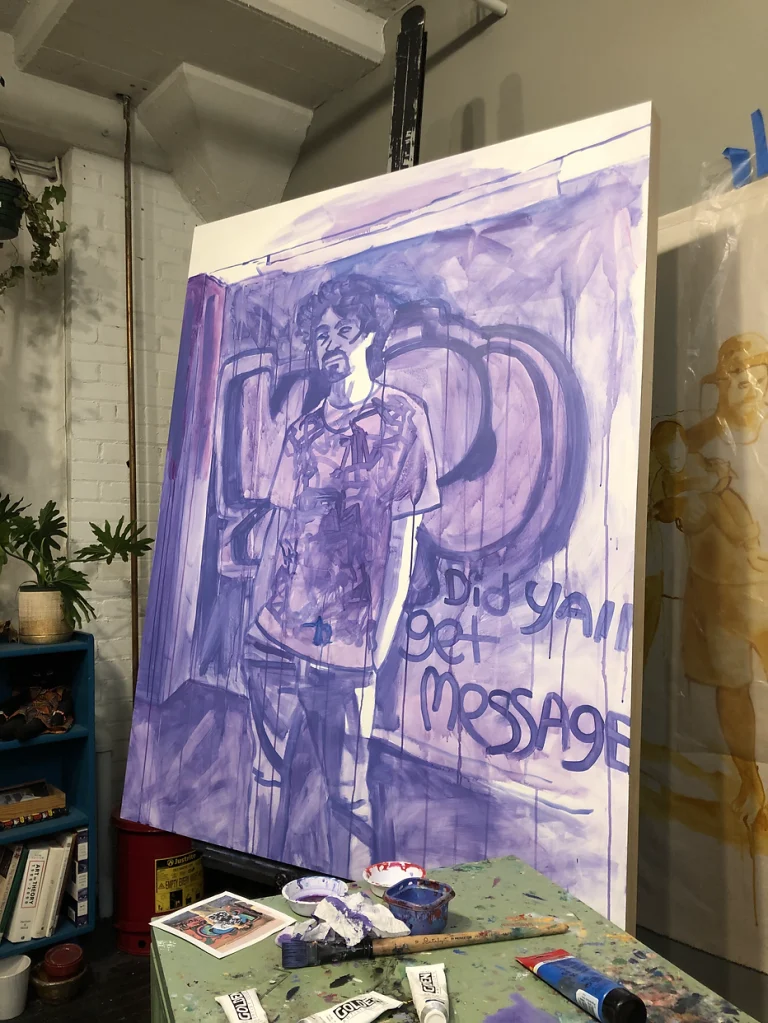
Within, Between, and Beyond is a multi-layered art installation and participatory experience sharing an evolving archive of stories from Black, Indigenous, and People of Color (BIPOC) who identify as Mixed Race or Transracial or Transnational Adoptee. Interviews for the video portion of the installation were conducted by Lola Osunkoya, who here introduces our subjects and shares a few highlights from their stories.

Alex self-identifies as a mixed race Black person, and uses he/him pronouns.

Alex, Leslie and I met on a hot summer day in 2020 outside of Juxtaposition Arts’ Textile Studio, in front of some graffiti works in progress. It didn’t take long for us each to realize it was our first time in safe space with just other Black/white mixed folks since the murder of George Floyd. We took the opportunity to compare and contrast our experiences as individuals and in community, reflecting on the complexity of being racialized in a variety of ways all our lives, while in this particular moment in history, being suddenly and completely racialized as Black by everyone, all races, for the first time in our lives. It was a poignant conversation.

Alex has a way of naming concepts that is simultaneously clear and plain, while very specifically descriptive. Regarding the erasure of your identity:

What happens when you’re a Black mixed kid in white spaces, developing your sense of identity in those environments? Wishing it was different… people either mess with you cuz you’re different or don’t acknowledge that you’re different.

Realizing that when you are mixed in white spaces, no one’s gonna tell you, “you’re mixed, you’re different,” or “You’re Black.” We’re just now having these conversations about race. There was none of that.

Before it was just like, you’re here… you’re something, maybe some people are gonna mess with you about that, most people are gonna ignore it and act like you’re like everyone else around you. Which is also problematic.

Alex also discussed his navigation of the ever popular and triggering question, “What are you?”

How I respond to that varies greatly on who’s asking and what the context is. If I can tell that someone is trying to figure out how to best direct their racism, then I’m going to give them a really hard time with that.

Well one of my favorite answers to that question is “what do you think I am?” And that usually gets an interesting answer, very rarely the correct one. So yeah, it’s a fun game.

Having that always be a question affects you for sure. Yeah, it’s a thing. And it’s something that I’m just now really unpacking. And I’m also realizing how much of my life I’ve spent doing everything possible not to address that. Because those are hard questions, and it’s really not that fun to think about. Especially when you’re young and you’re struggling with the issues of just being a young person anyway. And throwing issues of identity on top of that? Especially in MN? I fit in with not fitting in.

I can’t wait for you to see the rest of his interview and portrait at Mia! Within, Between, and Beyond runs 7/16/21-10/31/21.
Within, Between, Beyond

Kelly: Within, Between, & Beyond

Within, Between, and Beyond is a multi-layered art installation and participatory experience sharing an evolving archive of stories from Black, Indigenous, and People of Color (BIPOC) who identify as Mixed Race or Transracial or Transnational Adoptee. Interviews for the video portion of the installation were conducted by Lola Osunkoya, who here introduces our subjects and shares a few highlights from their stories.

Kelly self-identifies as multiracial transracial adoptee, and uses she/her pronouns.

We met Kelly in the summer of 2018, she was the last of our original four interviews. Kelly discussed a variety of topics related to her experience being enculturated in a South Dakota white adoptive family, being visibly brown.

Interviewing Kelly made me think a lot about stages of racial identity development, especially for multiracial people who grow up without the enculturation of their communities of color. Kelly was very candid in naming the ways she has negotiated identity over the years, sometimes in ways that admittedly made me uncomfortable. Usually because it was something I have done or experienced in my past in different stages of identity development or formation. She’s an incredibly courageous and determined person who at the time of the recording was still navigating ways to incorporate her Black identity.

I have identified with different races as a multiracial woman… German, Irish, African American, Indigenous. There’s been times where you have to fill out certain applications – a scholarship or job application where it’s required – and so I’ve checked different boxes throughout the years. Some of those boxes I’ve checked: Just multiracial, that’s easy enough. I’ve checked Black and white. And I’ve also checked just African American.

And I appreciate now that it’s more often optional, because I don’t want to be seen as a box, I don’t want to be classified and categorized.

But if there’s an advantage – like for a grant, if I’m more eligible for that grant because of a racial category, I’m gonna put that down.

When I’ve decided to select just African American as far as a category for my racial identity, that’s been because of how I see my skin, how others see my skin. There’s been times where I grew up having mixed friends where they’re a lot lighter in complexion. So I’ve always considered myself “dark for a mixed girl.”

That’s just how I see myself, and people have commented on that, like, “Oh, you’re mixed?” Without maybe looking at the thinner hair texture or the curlier hair, the other layers of your physical characteristics. But my skin tone, being darker, that’s when I’m like, well… I am more African American because I have darker skin.

And that is a part of my identity that I am still learning more about through my biological side, I wanna be that. Because I really wanna be closer to my African American identity. Because of my skin tone and because there is more to learn and to grow in that area. Because I haven’t been around that as much in my lived experience. And so that’s why sometimes I’ve chosen to mark that I’m just African American.

Because I am. I’m African American, I’m multiracial, I’m Black and I’m white. I’m an Indigenous woman. And I’m a mother.

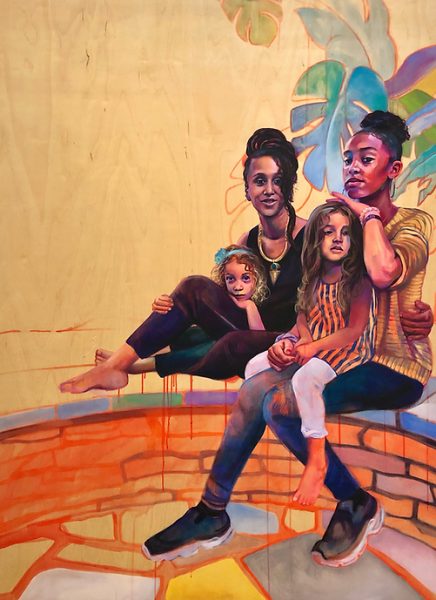
Come hear more of Kelly’s fascinating interview and view the incredible portrait of her with her daughters at Mia! Within, Between, and Beyond runs 7/16/21-10/31/21.

Within, Between, Beyond

Erin: Within, Between, & Beyond

Within, Between, and Beyond is a multi-layered art installation and participatory experience sharing an evolving archive of stories from Black, Indigenous, and People of Color (BIPOC) who identify as Mixed Race or Transracial or Transnational Adoptee. Interviews for the video portion of the installation were conducted by Lola Osunkoya, who here introduces our subjects and shares a few highlights from their stories.

Erin self-identifies as a mixed race Black woman, cis, and queer. Erin uses she/her pronouns.

I met Erin and her wife, Zoe, at the first MidWest Mixed Dialogue I ever attended! Brilliant and creative, I admired her as a collaborator on the first MWM Conference, volunteer activities, and when I hosted a writing workshop she facilitated. In our interviews for Within, Between, and Beyond, Erin had a really clear and nuanced take on her identity as a mixed Black woman.

I used to identify as biracial, that’s what I said when I was growing up. And I think that’s not untrue about me! I think I’m read in the world as a Black woman, and I enter spaces and I’m happy and honored to be part of a community of Black women.

My mixed identity is really important to me, and so I acknowledge it when I talk about it – in part because I’m crazy about my family and I love them very much and I want to signal them in my identity. But I know that for me, my identity as a Black woman is important, it’s a part of my lived experience. It’s not the only thing, but it’s important to me.

Being mixed and Black is not new in the history of our country, it’s from the foundations. There are people whose families have been mixed forever. It’s important for me to acknowledge the State in the ways that I identify, that the State has created violent relationships between the people I’m descendant from.

I’m a Black woman, and there are all different kinds of Black women. And I’m a Black mixed race woman. So both things are important for me to talk about.

As with many of us who have multiple identities and intersecting identities, Erin is able to hold a lot of complexity – both/and. Hear her speak more about this subject and other fascinating aspects of her experience – Within, Between, and Beyond runs 7/16/21-10/31/21 at Mia!

Within, Between, Beyond

Allison: Within, Between, & Beyond

Within, Between, and Beyond is a multi-layered art installation and participatory experience sharing an evolving archive of stories from Black, Indigenous, and People of Color (BIPOC) who identify as Mixed Race or Transracial or Transnational Adoptee. Interviews for the video portion of the installation were conducted by Lola Osunkoya, who here introduces our subjects and shares a few highlights from their stories.

Alison self-identifies as Hmong and Mexican and uses she/her pronouns.

Alison’s mom’s family came as refugees from the Secret War in Laos; dad’s family came from Mexico for better opportunities. Her parents met when each of them decided to go into the marine corps. They moved every 1-2 years until 5th grade when the family settled with Hmong relatives in Wisconsin. Prior to this, she had only periodic visits with either side of the family. While Alison initially identified as half and half, after exploring more of her culture and connecting with other multiracial people, she now identifies as both, as whole. Some of the first of these connecting experiences were through the MidWest Mixed Conferences.

I heard about MidWest Mixed through a friend who reached out about the conference and said, “I think this would be great for you.” But I couldn’t make it the first year, because I was living out of state. So when I finally came to the university, I reached out to see what this organization was about. I loved it!

When I went to the second conference, the topics had me shaken because there had never been a space for me before, for people with a multiracial identity. I was just speechless – I couldn’t even talk, my emotions were so high! I had never talked about my identity, I had never listened to anything. I didn’t realize there were so many people who were just like me, and different from me, in different places in their journeys, but willing to talk about it. In every other space I’ve been in, it hasn’t even been a discussion topic. It’s more just like… exoticized, like “this is so cool that they’re more than one race or more than one ethnicity.”

It’s not ever looked at as something hard to go through unless you know someone’s experiences. But with that conference and meeting those people I realized that it’s ok to struggle with my identity. It’s not all picture perfect of what society makes it out to be. It was overwhelming at first just because I was so happy and grateful. But I would hope that I would get to a point where I can speak to other people about my identity and verbalize how I feel, too.

What I love about Alison’s story is her perfect illustration of something common to a lot of mixed people: When you haven’t enculturated from birth into the parts of your identity, it can be a challenge to make your way into your heritage communities later in youth or adulthood. But something that can be so supportive is to find mixed communities of people whose stories may not exactly mirror yours, but where you can find people who navigate their worlds in similar ways as you. And it starts with a courageous first step to reach out.

Hear Alison’s full interview and see her beautiful portrait at Mia! Within, Between, and Beyond runs 7/16/21-10/31/21.

Within, Between, Beyond

Tricia: Within, Between, & Beyond

Within, Between, and Beyond is a multi-layered art installation and participatory experience sharing an evolving archive of stories from Black, Indigenous, and People of Color (BIPOC) who identify as Mixed Race or Transracial or Transnational Adoptee. Interviews for the video portion of the installation were conducted by Lola Osunkoya, who here introduces our subjects and shares a few highlights from their stories.

Tricia self-identifies as Thai American and uses she/her pronouns.

Tricia was born in Thailand to a Thai mother and American father. She is our only participant raised outside of the US. Coming to Macalester for college when she was 18 provided a unique perspective on American culture and racial experiences.

Living in other places as an American and as a mixed race person, I was kind of the other. In Egypt, I was always aware of not being Egyptian. And you have a place of privilege being an American living in those types of countries. It’s just a different orientation. I didn’t worry so much about my race or identity there. Here, it became a lot more complicated.

I did live in sort of a bubble growing up – I went to an international school, everyone around me had lots of diverse identities, lots of people growing up in a different culture and being used to orienting to a different culture. So that’s kind of the ideal, and it’s something that I tried to create when I moved to the Twin Cities in the arts community that I’ve tried to build around me through the space that I run and all the projects around me that I’m involved with… I feel most comfortable around other mixed people, my close friends and collaborators.

Another shift coming to the states was the opportunity to spend more time with her father’s side of the family, yet noticing that whiteness did not feel like a fit to her identity.

Even though my father’s family is white, I don’t feel that comfortable in all white spaces when I’m the only person of color. There’s not a part of my white self that’s like “oh you’re ok here!” I still don’t feel ok, something doesn’t quite feel calm.

A stabilizing decision around incorporating all of the pieces of her heritage was to reject certain terminology and to claim herself as whole, as Thai American.

I don’t say “half” anymore. My father is white, but I am not. Not quantifying makes more sense for me. I came to terms with the fact that my father is white, but I am not white. That was a big moment that went off in my head like, that is him, and I’m a different generation, I’m a different person than him. I felt so much more in myself when I was able to not half or portion, to not use that terminology.

Tricia is such a brilliant and beautiful light in our exhibition. Come and see her full interview and portrait at Mia! Within, Between, and Beyond runs 7/16/21-10/31/21.

Within, Between, Beyond

Carolina: Within, Between, & Beyond

Within, Between, and Beyond is a multi-layered art installation and participatory experience sharing an evolving archive of stories from Black, Indigenous, and People of Color (BIPOC) who identify as Mixed Race or Transracial or Transnational Adoptee. Interviews for the video portion of the installation were conducted by Lola Osunkoya, who here introduces our subjects and shares a few highlights from their stories.

Carolina self-identifies as Chilean American, an indigenous person of Chile, North Dakotan, bicultura, and a transracial/transnational adopteel. Carolina uses she/her pronouns.

We met with Carolina in the summer of 2018, when she had recently returned from living in Chile for a few years. Much of the beauty in her interview was that in a way, she was both telling her story and processing it for the first time. Carolina was adopted as a young child into a white family in North Dakota, but always noticed a difference.

My adoption was diminished as just the way they acquired me. But they didn’t want it to define me – I was their own. This was conflicting as an adult, because I was curious about the other side of me that I wasn’t getting… the physical differences. I stuck out, I was exotified, I was different than my peers. I wasn’t comfortable to express this to my parents, for fear of hurting them. I was a people pleaser. These experiences and messages spoke loudly, and the silence spoke very loud to me.

Many adoptees have a significant relationship with “the file” – a packet of information about their adoption. Adoptive families vary greatly on how much they share the contents of the file with adoptees, and Carolina’s experience was complex.

I was given the legal paperwork right before my trip – it wasn’t available to me until there was a purpose for it. There was a whole file. I searched when my parents weren’t home. It was shocking to know it existed and as an adult it wasn’t given to me, even when I asked. I think this was more to protect them and their feelings, not being ready to address it with me. For my family, this trip and the file was scary for them, they associated my trip with leaving, separating, losing me. Which was never on the table for me. Not having the communication skills has been difficult for us.

Finding and meeting took two years of baby steps and identity crises. I experienced depression and anxiety, I even saw a therapist there for 4 or 5 months. Reunion was a joyous moment, she was so beautiful she couldn’t be my mother! Because adopted children dream of their mothers when they have that absent image… to have that woman in front of you in flesh and blood open her arms, that filled a big void.

To hear the full story on how Carolina located her birth mother, and what she learned about herself in the process, be sure to come to the exhibition at Mia! Within, Between, and Beyond runs 7/16/21-10/31/21.

1 2

Stay in touch & join the conversation!

Our newsletter is a great way to stay on top of all things MidWest Mixed!

Get Involved
Donate
Get Involved
Donate